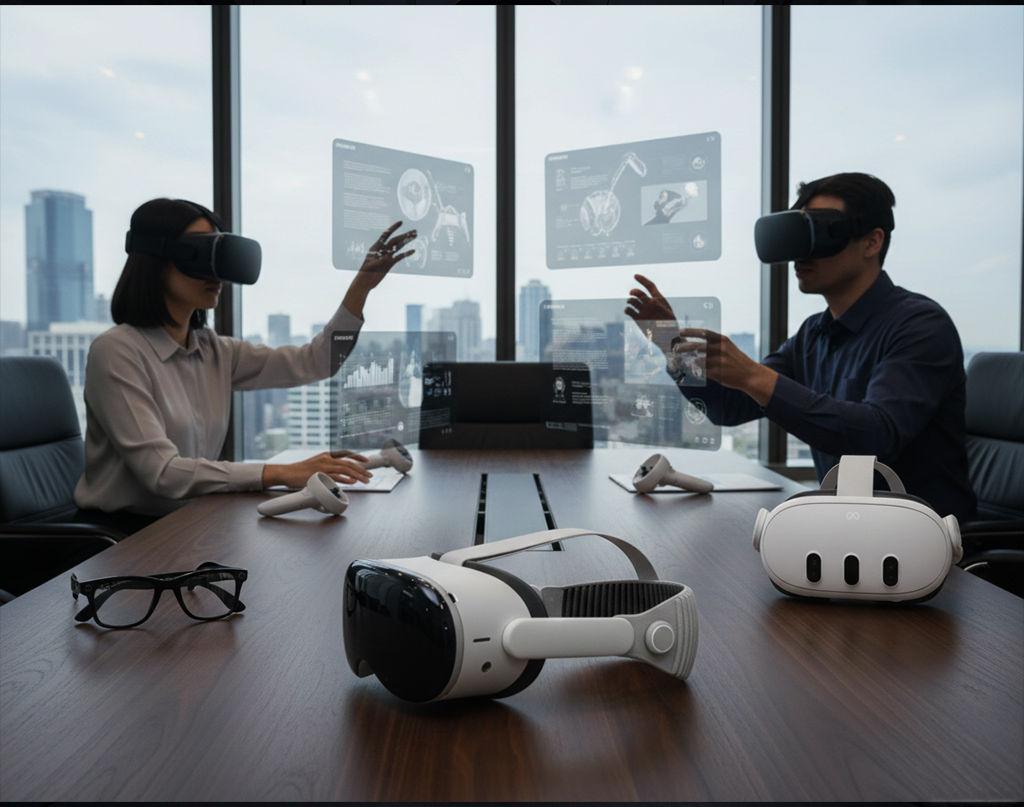
Strategy for the future, and training

We help companies understand and build XR into their workflows through consultancy and specialist training.

We analyse what you need and draw up a roadmap for adopting virtual and augmented reality, with a clear return on investment. We join your team for a while to understand how your company actually works day to day.

  • Technical feasibility analysis and KPIs
  • XR product design and workflows
  • Corporate training and technology adoption
  • Choosing the hardware and the technology ecosystem
XR consultancy

High-impact corporate workshops

Exclusive hands-on training programmes in immersive technology and AI, tailored to your organisation

Nivel Directivo

Executive and board workshops

Strategic sessions designed for boards. A practical focus on AI and immersive technology.

  • Understanding the state of the art, and benchmarking
  • Identifying strategic opportunities to put it to work
  • Duration: half a day (10–15 people)

Nivel Organizacional

Transformación Organizacional

A full digital transformation programme adapted to every level and role in the organisation.

  • Bringing the whole organisation up to speed
  • Building capable teams in each area
  • Modular programme (groups of 10–15)

Events

Corporate talks and conferences

Compelling demonstrations of immersive technology put to practical use, for large events.

  • Demonstrating real-world applications of the technology
  • Inspiring and driving engagement
  • Duration: 30–40 min (flexible audience)
Frequently asked questions

Common questions

Do you offer technology consultancy to small businesses?
Yes, and it is where it makes the most difference. Technology consultancy for a small business avoids the expensive mistake: buying kit or commissioning a build that nobody ends up using. Half a day of analysis is usually enough to know whether the use case stands up, and it costs far less than finding out halfway through the project.
What is the difference between virtual reality and mixed reality consultancy?
Virtual reality applies when the person needs to be cut off from their surroundings: training on hazardous procedures, simulations, visits to places you cannot reach. Mixed reality fits when the person has to keep seeing the real environment with the content layered on top: maintenance on the machine itself, design review at full scale, remote assistance. Getting this choice wrong is the single most common reason a project ends up unused.
What do I get if the project does not go ahead?
The report, with the analysis and the reasoning. A conclusion of "this is not worth it for you today" is a valid outcome, and a far cheaper one than the build you would otherwise have commissioned.